
By DR. BAYNE FRENCH M.D. D.C.
There is something special about sugar, beyond its heavenly taste. It seems that sugar is capable of doing things that other sources of carbohydrates just can’t pull off. It’s so special in fact, that it’s “toxic,” according to researcher Dr. Robert Lustig. He concluded that sugar has dramatic detrimental effects on metabolic health irrespective of calories or changes in weight.
In a 2015 study originally published in Obesity, and later in TIME magazine, Dr. Lustig simply replaced, calorie for calorie, all the sugar that a group of adolescents ate with starch. Yes, you read this correctly. They replaced sugar carb with complex, starchy carb. The results were alarming. These adolescents lost weight, they went from insulin resistant to insulin sensitive, and had much less fat in their liver. Lustig states, “We gave them crappy food, shitty food, processed food-and they still got better. Imagine how much even better they would have gotten if we didn’t substitute, and took sugar out.”
Prior to this, many studies established correlation between sugar and metabolic disease; many feel this study proves causation. Sugar IS special, in a sinister, toxic kind of way.
I have observed similar findings in my adult patients. Athletes who fuel with simple carb/sugar show similar laboratory results to obese, poorly controlled diabetic patients: Elevated blood sugar and insulin levels, high triglycerides, low HDL (favorable cholesterol), small and dense LDL (bad cholesterol) particles, and high CRP (inflammatory marker).
As discussed in “The Scoop on Sugar” in EN #117, sugar (sucrose) is made up of glucose and fructose in equal amounts. High fructose corn syrup has 75% fructose. Every cell in our body can metabolize glucose, but only the liver can process fructose. Sugar hits the bloodstream like a freight train, stimulating the liver to produce fat in a process called lipogenesis. I’m told foie gras (made from over-fattened duck’s liver) is delicious, but it’s not a healthy situation for the ducks, and same goes for us.
Another interesting observation I’ve made over the years in sugar eaters and drinkers who are lean is that they can have isolated liver enzyme elevations. Their blood sugar and cholesterol profile may be normal, yet their liver is inflamed despite low levels of alcohol consumption. A liver ultrasound report commonly states “increased echogenicity, suggestive of steatosis.” Fatty Liver Disease. I read recently where this practice of feeding ducks and geese large amounts of carb to form yummy fatty liver is now considered inhumane in the culinary world. I don’t disagree, but it’s hard not to laugh, as many people do it to themselves at every meal, snack, and training session. Here I go… I’m coining it…FGISEAS (Foggy Seas)—Foie Gras In Sugar Eating Athletes Syndrome.
Let’s talk about immune function for a moment. I can remember my mother saying “if you eat that you’re gonna catch a cold” in reference to some next-to-never sugary treat I had access to in my strange upbringing. What a smart lady. Many articles reference a 1973 study published I consider the evidence irrefutable that sugar (meaning all simple carb sources) are not benign substances, even though our brain drives us to seek them out. in The American Journal of Clinical Nutrition, where immune function was measured after sugar consumption. Phagocytosis is a process where white blood cells literally engulf microbial invaders (viruses, bacteria, fungi). They have a zero tolerance policy for outsiders, which makes them the O.X., Original Xenophobes. Blood was drawn from a willing participant multiple times after consuming some sugary crap. Their blood was then incubated with Staphylococcus epidermidis, a bacteria that commonly lives on our skin. The “phagocytic index,” which is the number of bacteria observed within each white blood cell, was then measured. The decrease in the phagocytic index was rapid following the ingestion of simple carbohydrates. The effect was greatest 1–2 hours after sugary nastiness was consumed but extended for at least 5 hours. The number of white blood cells was not reduced; only their function was impaired.
There were two other very interesting observations:
- This impaired immune function was seen only with consumption of simple carbohydrates like glucose, fructose, sucrose, and orange juice. Longer chain, complex carbohydrates did not have this effect.
- Fasting for 36 hours or more significantly increased the phagocytic index (refer to EN #123 and #124 for my two articles on intermittent fasting). Now more than ever I want my white blood cells to phagocytize basically anything that moves. And then there’s heart disease. What is worse than heart disease? Dying from heart disease. Most previous studies focused on sugar-sweetened beverages and their effect on weight gain, obesity, distorted cholesterol, type 2 diabetes, high blood pressure, and cardiovascular disease (CVD). JAMA Internal Medicine looked at total sugar consumed (solid and liquid) and the risk of actually dying from CVD, using data collected via NHANES (National Health and Nutrition Examination Survey). This is a series of surveys of the US population that in 1999 became a continuous program. It consists of a comprehensive interview and a physical examination of each survey participant.
Added Sugar Intake and Cardiovascular Diseases Mortality Among US Adults
This study was comprised of two components:
- Analysis of total sugar consumption
- The association of this consumption with CVD mortality (becoming dead)
Over 30,000 individuals were included in this study over the course of decades and it became pretty apparent that to enhance your probability of remaining undead, super minimization of sugar is advisable.
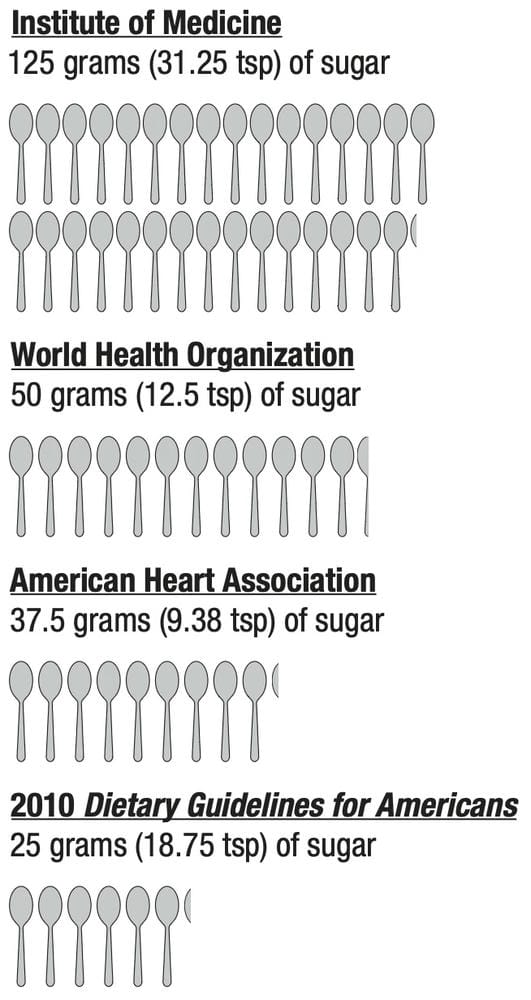
There is no universally accepted guideline for limiting added sugar consumption. The World Health Organization (WHO) recommends that less than 10% of daily calorie consumption should be from added sugar. The Institute of Medicine recommends that no more than 25% of your daily calories should be from added sugar. A quarter of our daily caloric consumption from added sugar? Are these people serious? Are we being punked? At least there is the strong verbiage “no more than!” One can of soda contains about 35 grams of sugar, so if you consume about 2000 calories 26 Endurance News 126 hammernutrition.com per day, make sure you consume “no more than” 4 cans of soda per day. One sip more and you’re done for!
Inconsistency in added sugar consumption recommendations
*Numbers based on a 2,000 calorie diet.
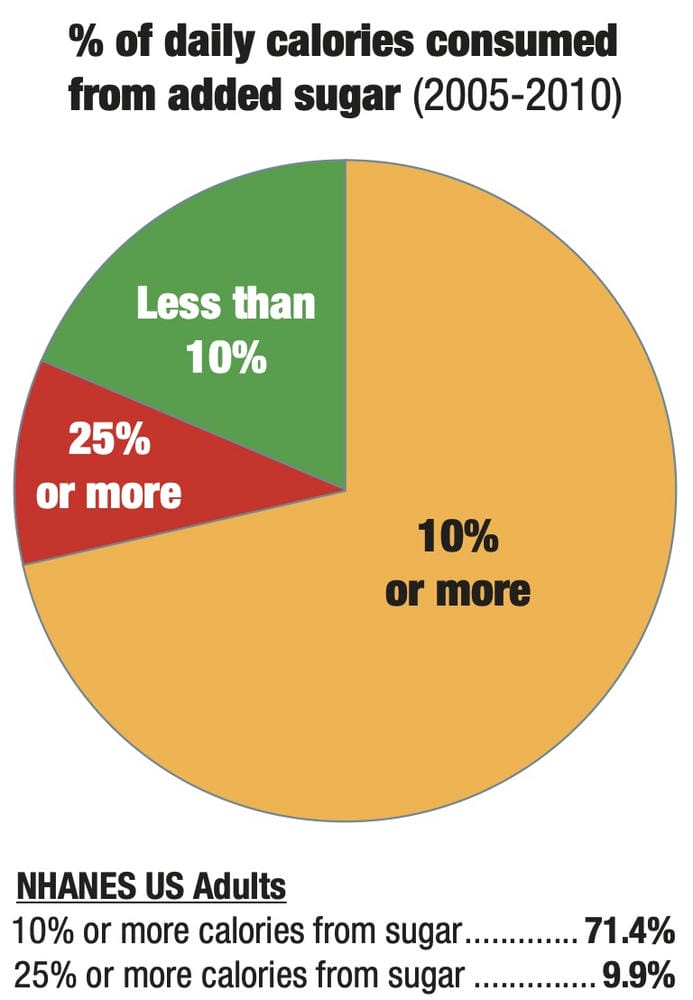
I know what you’re thinking, ”So what did the study show, ‘Frenchy,’ you desk-pounding fanatic!?” Participants who ate or drank sugar greater than or equal to 10% but less than 25% (the level below the Institute of Medicine recommendation and above the WHO recommendation) had a 30% higher risk of dying from CVD. Yes there’s supposed to be a 0 after that 3. And for those who thumbed their nose at the generous Institute of Medicine recommendations and consumed more than 25% of their calories from added sugar, their risk was nearly tripled. Maybe there are a few regular exercisers out there reading this. And maybe you’re thinking the rules of biochemistry somehow don’t apply to you because you just “burn it off.” Well unfortunately the observed association between sugar and dying was consistent across age, gender, race, educational levels, weight, and physical activity levels.
I consider the evidence irrefutable: sugars (meaning all simple carb sources) are not benign substances, even though our brain drives us to seek them out. Patients with diabetes, whose blood sugar is chronically elevated, have a dramatic increase in disease burden, including infections. But the consequences from repetitive blood sugar spikes following a soda, sports drink or sugary snack cannot be discounted. Dr. Lustig showed that sugar had particular nasty metabolic effects on young people that longer chain, complex carb sources just did not. And in the early 1970s simple sugar carb sources, not complex carb sources, were shown to directly inhibit our immune system’s ability to kill germs. Enjoying one’s diet is paramount, and I’m not a zealot, but choosing to reserve your dietary and exercise carb choices to quality, organic, and complex sources makes very good biological sense to me. I see people every day who have lost the ability to move their bodies. This glorious act many of us take for granted is lost to them. It behooves us fortunate souls that still possess this gift, and regularly do it at exhaustive levels, to eliminate the ingestion of disease-promoting toxic sugar. The healthiest people I see have demoted sugar from a staple to an occasional garnish. And that’s what I try to do.
← Back to Articles-

Email
Our team is dedicated to providing personalized care and guidance tailored to your individual needs.
Email Us -

Phone
Take the first step towards a healthier you today!
(406) 405-1457 -

Office
We look forward to seeing you.
Whitefish Medical
144A 2nd St
Whitefish, MT 59937